Pixels With Purpose: How TDU's Obsessive Authenticity Quietly Reshaped the Way Automakers Sell Dreams
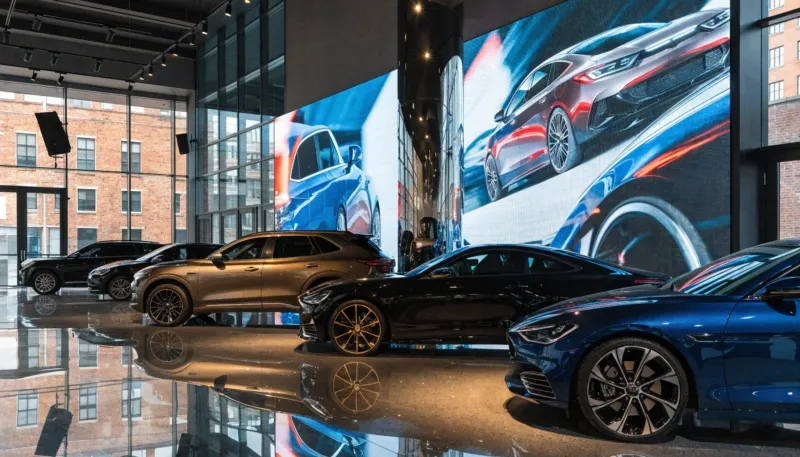
Photo: luxury hypercar showroom digital display screen automotive marketing, via www.nseled.com
There's a moment a lot of TDU veterans remember clearly. You'd fire up the game, walk into a virtual dealership on Oahu, and stand in front of a Lamborghini Murciélago rendered with almost uncomfortable accuracy — every vent, every seam, every curve sitting exactly where it should. You weren't just looking at a car. You were studying one. And apparently, so were the people who make them.
The relationship between gaming and the automotive industry has always been a two-way street, but for a long time, manufacturers treated games as little more than a licensing deal and a check. TDU changed that dynamic. By demanding painstaking authenticity from every vehicle it featured — correct performance specs, real interior layouts, actual dealership branding — it signaled to automakers that gamers weren't just casual fans. They were the most attentive audience in the room.
The Authenticity Arms Race That TDU Started
Before Test Drive Unlimited dropped in 2006, most racing games treated real cars as rough approximations. You got the shape, maybe the badge, and a ballpark number on the speedometer. TDU's development team, working with Atari and Eden Games, pushed hard for licensing agreements that went deeper than a logo slap. They wanted accurate engine sounds, real gear ratios, and interiors that matched what you'd actually find if you opened the door of a Ferrari 575M in the real world.
That level of detail didn't go unnoticed in boardrooms. When a game ships millions of copies and players spend hours inside a virtually recreated version of your product — learning its proportions, memorizing its dashboard, debating its performance ceiling on forums — that's an entirely different kind of brand exposure than a thirty-second TV spot.
The shift in how manufacturers thought about gaming partnerships didn't happen overnight, but TDU was among the first titles to demonstrate that a game could function as an extended, interactive product brochure. One that players chose to spend time with.
When the Showroom Goes Digital
Fast forward to the early 2010s and you start seeing something interesting happen. Automakers — particularly those in the hypercar and luxury segments — began structuring their real-world reveal events with an almost game-like sensibility. Teaser campaigns borrowed the drip-feed approach that gaming had normalized. Lamborghini's Huracán launch, Bugatti's Chiron reveal, McLaren's entire brand reboot around the MP4-12C — all of them leaned into digital-first strategies that treated the online audience as the primary one, not an afterthought.
That's not a coincidence. The generation of consumers those brands needed to convert had grown up with games like TDU, Gran Turismo, and Forza. They already had strong opinions about these cars. They'd already driven them — virtually — thousands of times. Manufacturers learned, slowly but surely, that the most effective way to market to that demographic was to meet them in the spaces they already occupied.
Gaming partnerships became prestige moves. Ferrari, historically one of the most protective brands on the planet when it came to licensing, started loosening its grip. Pagani, a brand so boutique it barely needs advertising, signed on with titles that gave its cars a global stage. The pattern was clear: the right game, with the right level of authenticity, was worth more than a full-page spread in a luxury magazine.
Design Language and the Feedback Loop
Here's where things get genuinely fascinating for anyone who cares about where cars come from aesthetically. There's a credible argument — floated in automotive design circles and occasionally surfaced in industry publications — that the feedback loop between gaming and real-world design has become a genuine two-way influence.
When a car is rendered in a game with the kind of fidelity TDU demanded, design teams get to see their work from angles and in lighting conditions that physical clay models and photoshoots don't always capture. Some designers have noted, in interviews over the years, that gaming partnerships gave them unexpected data points — which visual elements resonated with players, which details got called out on forums, which proportions generated the most passionate responses.
That's not nothing. Design studios are obsessive about consumer perception, and the gaming community, with its forensic attention to detail, became an accidental focus group. TDU's forums were full of players debating whether the Aston Martin DB9's front grille was proportioned correctly, whether the Porsche 911's rear haunches read right in motion. That conversation, multiplied across millions of players, fed back into a broader cultural dialogue about what these cars meant and what made them desirable.
The Marketing Pipeline Gets a Remodel
Modern automotive launches look fundamentally different from how they looked in 2005, and gaming culture deserves a significant share of the credit. The standard playbook now includes gaming integrations as a core pillar, not a side note. When Koenigsegg or Rimac or any number of electric hypercar startups wants to introduce a new model to an American audience that skews younger and digitally native, they don't just send it to a car show. They put it in a game.
This strategy works because it leverages exactly what TDU understood before almost anyone else: that driving a car — even virtually — creates an emotional connection that passive advertising simply cannot replicate. You don't just see the car. You feel its weight in a corner, hear its engine note on a straightaway, make decisions about when to push it and when to hold back. That's brand loyalty being built in real time.
For American consumers especially, where car culture is deeply tied to personal identity and aspiration, the gaming-to-showroom pipeline has become one of the most effective tools in a manufacturer's arsenal. And the groundwork for that pipeline? TDU helped lay it.
Legacy Beyond the Leaderboard
It's easy to look back at Test Drive Unlimited as simply a great open-world racing game — and it was. But its cultural footprint extends into territory that most gaming retrospectives don't bother to explore. By insisting on authenticity, by treating its vehicle roster as something worth getting right, it elevated the standard for what a gaming partnership with an automaker could look like.
The ripple effects are visible in everything from how Bugatti handles its social media presence to how startup EV brands position themselves as aspirational objects before they've even delivered a single car. The language of gaming — immersion, authenticity, community-driven hype — has become the language of modern automotive marketing.
TDU didn't just let you drive your dream car. It helped define what dreaming about a car even looks like in the twenty-first century. And for a game that launched on a PS2 and a first-generation Xbox 360, that's a legacy worth sitting with for a minute.
Next time you're watching a hypercar reveal that feels more like a game trailer than a press release, remember: somebody in that marketing department probably logged a few hundred hours on Oahu.