Under the Hood and Into Your Head: How TDU's Tuning System Rewired a Generation of Racers
There's a moment every TDU veteran remembers. You've just bought a Dodge Viper, you're sitting in the garage menu, and instead of slapping on a flashy livery and calling it a day, you find yourself staring at suspension damping rates. You don't fully understand what you're looking at — yet. But something about the way the game presents those numbers makes you feel like they matter. That instinct was exactly right. TDU's tuning philosophy wasn't decoration. It was an education hiding in plain sight.
For a lot of American players who came up in the mid-2000s, racing games were basically paint-by-numbers. Pick your car, pick your color, maybe bolt on a spoiler that did nothing, and go race. TDU blew that template apart. Eden Games built a system where the mechanical choices you made in the garage had genuine, readable consequences on the road. That wasn't accidental — it was a design philosophy rooted in authentic automotive thinking, and it changed what players across the country quietly started expecting from the genre.
More Than Sliders: The Real Mechanics Behind the Menu
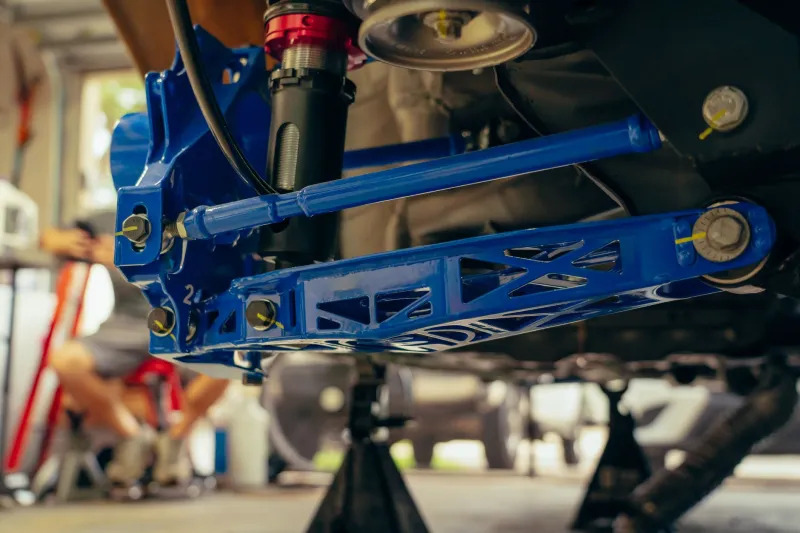
Pull up any TDU tuning screen and you're not just moving a bar from "soft" to "hard." The game breaks performance modification into categories that map almost directly to real shop work: spring rates, anti-roll bar stiffness, brake bias, gear ratios, ride height. These aren't cosmetic labels. Change your front spring rate too stiff on a Lamborghini Murciélago and you'll feel the front end pushing wide through high-speed corners. Dial in too much rear brake bias and the back steps out on hard stops. The feedback loop was tight enough that players couldn't fake their way through it.
What Eden Games accomplished — whether fully intentional or not — was encoding real suspension geometry logic into an accessible console interface. The kind of knowledge that used to live inside Chilton manuals and late-night forum threads suddenly had a visual, interactive home. You could feel the result of your choices within minutes of making them, which is something no textbook has ever efficiently delivered.
Players Who Learned to Wrench Because of a Video Game
Spend any time in TDU communities and you'll find them — the players who credit the game with sparking a genuine mechanical curiosity. One longtime community member from outside Nashville put it plainly in a forum thread that circulated a few years back: "I didn't know what oversteer actually meant until TDU made me experience it at 140 miles per hour on a virtual Hawaiian highway. After that, I started reading about why it happens. Six months later I was corner-balancing my Miata in my driveway."
That's not a unique story. It's practically a archetype in TDU circles. The game had a way of making automotive concepts feel personally urgent. When you're trying to chase down a rival in a time trial and your car keeps breaking loose, you want to understand why. You go looking for answers. You find real answers. Suddenly you're on forums discussing camber gain and unsprung weight, and you're not entirely sure how you got there.
That pipeline — from game mechanic to genuine automotive literacy — is part of what makes TDU's legacy so distinct from other racing titles of its era. Gran Turismo gets rightfully celebrated for depth, but TDU's tuning system felt approachable in a specifically American way. It wasn't intimidating. It was inviting. You could go as deep as you wanted, and the game rewarded every level of engagement.
Gearing and Aerodynamics: The Details That Separated TDU From the Pack
Two areas where TDU really separated itself were gearing customization and aerodynamic tuning. Most contemporary racing games treated final drive ratio as a footnote — if they included it at all. TDU made it a genuine strategic decision. Running a longer final drive on a straight-heavy course versus tightening it up for a twisty canyon road wasn't just theoretical. Players who actually experimented with it found real lap time differences. That kind of mechanical cause-and-effect taught gear ratio logic better than most automotive science classes.
Aerodynamics in TDU were handled with similar respect. Adjusting downforce levels on cars that actually supported it produced measurable changes in high-speed stability and cornering grip. You weren't just watching a number change — you were feeling your car transform. For players who'd never considered the relationship between a rear wing angle and high-speed cornering balance, TDU was a quiet revelation.
The Ripple Effect on Modern Racing Games
Fast forward to today and it's hard not to see TDU's fingerprints on how modern titles approach tuning depth. Forza Motorsport's detailed setup menus, the granular suspension options in Gran Turismo 7, the way Assetto Corsa Competizione presents alignment data — these systems exist in a world that TDU helped build an appetite for. Players who came up with TDU arrived at those games already expecting tuning to mean something. They weren't satisfied with visual-only customization, and the market responded.
Game developers noticed that a segment of players — a passionate, vocal, community-building segment — wanted the garage to be as engaging as the track. TDU proved that audience existed and that they'd invest real time and attention into mechanical systems if those systems delivered real feedback. That's a design lesson that still echoes through the genre.
The Legacy Lives in the Details
What made TDU's tuning philosophy genuinely special wasn't that it was the most technically accurate racing sim on the market. It wasn't. What made it special was the intention behind it — the sense that the developers respected players enough to give them real tools and trust them to figure it out. That respect translated into a generation of American players who learned to think about cars differently.
When you talk to TDU veterans today, the tuning memories are always vivid. The first time a suspension change actually fixed a handling problem. The gear ratio that finally made a muscle car feel right on a long stretch of open road. The moment the aerodynamics settings stopped being abstract and started feeling like something you understood. Those aren't just gaming memories. They're the foundation of a mechanical intuition that plenty of TDU players carried right out of their living rooms and into real garages.
That's the real legacy of TDU's tuning system. Not the sliders, not the menus, not the numbers. It's the curiosity it sparked — and the knowledge that curiosity eventually built.